


















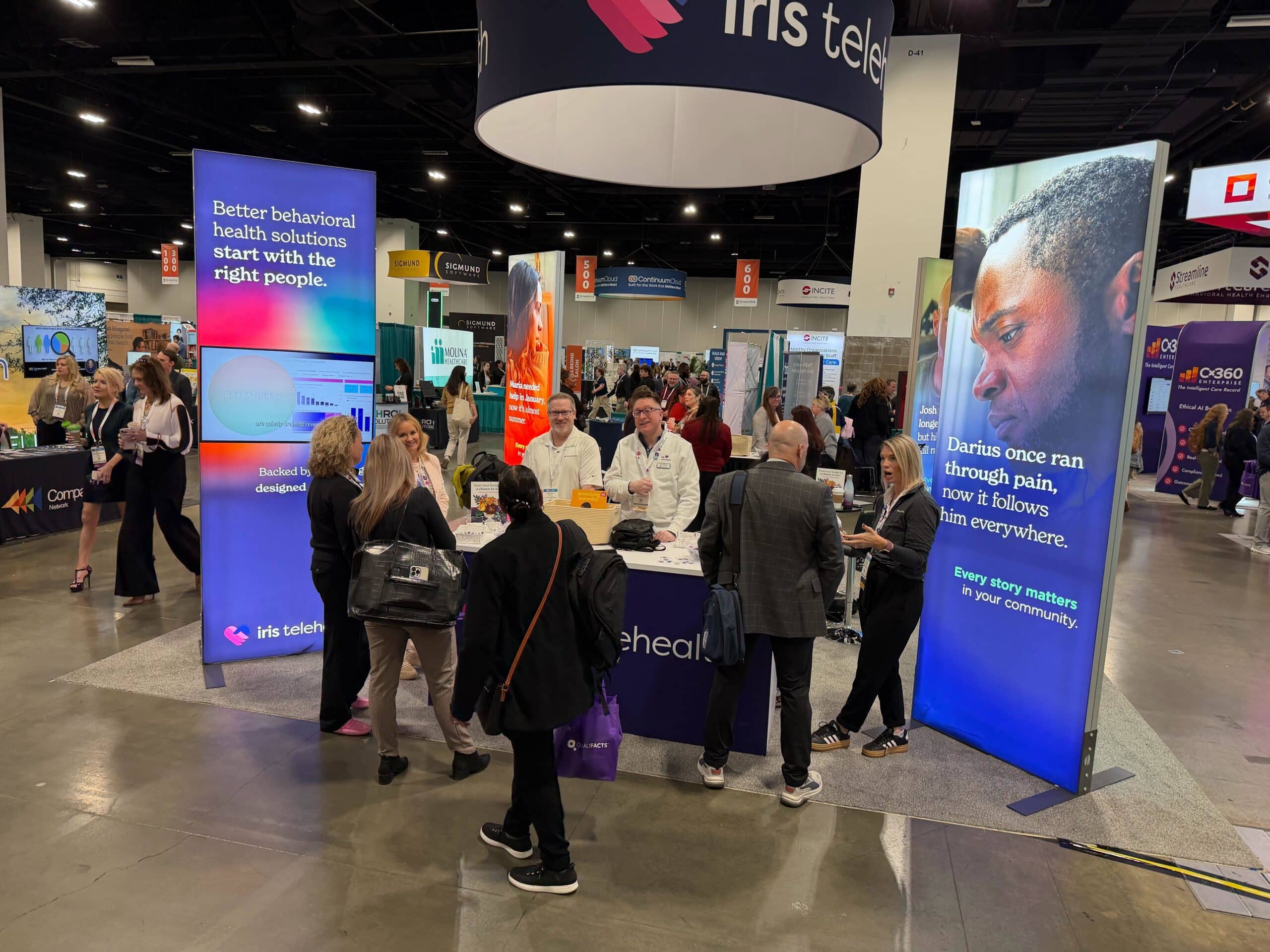
More than 4,000 behavioral health leaders, clinicians, advocates, and innovators gathered at the Colorado Convention Center in Denver this week for NatCon 2026. And if the conversations at Booth #601 were any indication, the field is navigating one of its most consequential moments in decades.
Here’s what the room was telling us.
The Funding Crisis Is Real, and Organizations Are Adapting in Real Time
If there was a single conversation that surfaced everywhere at NatCon26 — in the general sessions, the breakout rooms, the hallways, and the expo floor — it was this: What do we do when the money we built our programs on disappears?
The rollback of federal behavioral health funding under the current administration has created a crisis-within-a-crisis for organizations that were already operating on thin margins. Community mental health centers, FQHCs, CCBHCs, and integrated health systems are all confronting the same brutal arithmetic: the populations they serve have never had greater need, and the resources available to serve them are contracting.
What struck us most, though, wasn’t despair. It was determination. Leaders across the country aren’t waiting to be rescued. They’re pivoting — fast.
We heard about organizations diversifying their revenue by building out managed care and commercial payer contracts. Others are pursuing CCBHC Medicaid certification to access cost-based reimbursement as a more stable foundation than grant funding. Some are deepening integration with primary care and health systems to participate in shared savings arrangements. Others still are consolidating programs, collapsing administrative redundancies, and forging partnerships with peer organizations to share overhead without sacrificing care.
None of these strategies are easy. And none of them are possible without one thing that most behavioral health organizations told us they’re still missing: real-time visibility into their own operations.
You can’t pivot on data you don’t have.
You can’t negotiate a payer contract you can’t support with outcomes evidence. You can’t protect your most essential programs if you can’t see which ones are performing and which ones are at financial risk.
This is where Iris Insights was built to help — giving organizations the financial and clinical visibility they need to make confident decisions, even under pressure.
The Metrics Are There — But the Path to Improvement Isn’t
The second theme that surfaced at NatCon26 was nearly universal: a disconnect between the quality metrics organizations are measured on and the day-to-day reality of delivering care.
Leaders across clinical, operational, and executive roles described the same pattern. A quarterly scorecard arrives. The numbers are there — some trending in the wrong direction. But the connection between those numbers and what’s happening on the ground isn’t clear. What’s being measured? Why does it matter? What, specifically, would move it?
Without that clarity, even the most committed care teams are left guessing. Reports get reviewed. Then filed. And the next quarter looks much the same.
This isn’t a failure of effort or expertise. It’s a gap in how the system translates measurement into action.
HEDIS measures, UDS benchmarks, CCBHC requirements, and payer scorecards were designed to reflect meaningful aspects of care. But they only create value when the people delivering that care can see how their decisions influence those outcomes. When that connection is missing, strong teams can appear to underperform — and organizations lose the ability to improve performance, strengthen contracts, or clearly demonstrate their value.
The organizations at NatCon 2026 that described the most momentum weren’t generating more reports. They were making those connections visible — aligning data to workflows in a way that shows teams what’s happening and what to do next.
That’s the philosophy behind Iris Insights. Not just surfacing metrics but connecting them to the work that drives them — so that when a gap appears, teams understand what it means and how to respond.
Data that doesn’t lead to action isn’t insight. It’s noise.
AI Is Everywhere — and Behavioral Health Leaders Are Asking Exactly the Right Questions
The expo hall at NatCon 2026 was loud with AI. Dozens of vendors showcased tools powered by artificial intelligence — for clinical documentation, risk stratification, scheduling, patient engagement, and outcomes prediction. The innovation was real. So was the skepticism from the leaders walking the floor.
Behavioral health providers have seen technology waves before. They know the difference between a compelling demo and a solution that holds up in clinical practice. What we heard from leaders wasn’t resistance to AI — it was a sophisticated, hard-won demand for AI that earns trust before it asks for it.
The questions they were asking were exactly the right ones: Who built this? On what data, and from what populations? How does it perform when the patient in front of me doesn’t look like the training set? What happens when it’s wrong?
At Iris Telehealth, our answer is straightforward: behavioral health intelligence needs to be built by behavioral health specialists. It needs to be validated against behavioral health populations. And it needs to support — not replace — the clinical judgment of the people providing care. That’s not a marketing position. It’s a design constraint we hold ourselves to every time we build something new.
What We Heard at Booth #601
We had hundreds of conversations over two days in Denver. The Iris Insights demo drew leaders from health systems, FQHCs, community mental health centers, and CCBHCs — organizations at every stage of their telehealth and analytics journey.
The reaction we heard most often, from leaders seeing the platform for the first time, was some version of:
“I didn’t know I could have this kind of visibility into my program.”
That response tells us everything we need to know about where the field is and where it needs to go. The behavioral health sector has operated for too long without the data infrastructure that other areas of healthcare take for granted.
Iris Insights was built to close that gap — with dashboards that reflect how behavioral health actually works, performance measures connected to the care decisions that drive them, care gap alerts that surface before patients fall through the cracks, and workforce health indicators that help leaders see clinician burnout risk before it becomes turnover.
Not data for data’s sake. Data that moves organizations forward.
Where We Go From Here
NatCon 2026 reinforced something we believe deeply: behavioral health is not a field in decline. It is a field under pressure — and the leaders navigating that pressure are some of the most committed, creative, and capable people in healthcare.
What they need right now isn’t inspiration. They have plenty of that. What they need is infrastructure — tools, data, and partners that help them see clearly, demonstrate their value, and make decisions with confidence.
That’s what we’re here to build.
Continue the Conversation
If you were in Denver and want to keep talking — or if you missed NatCon 2026 and want to see what Iris Insights can do for your organization — we’d love to connect.
Schedule a Demo → www.iristelehealth.com